

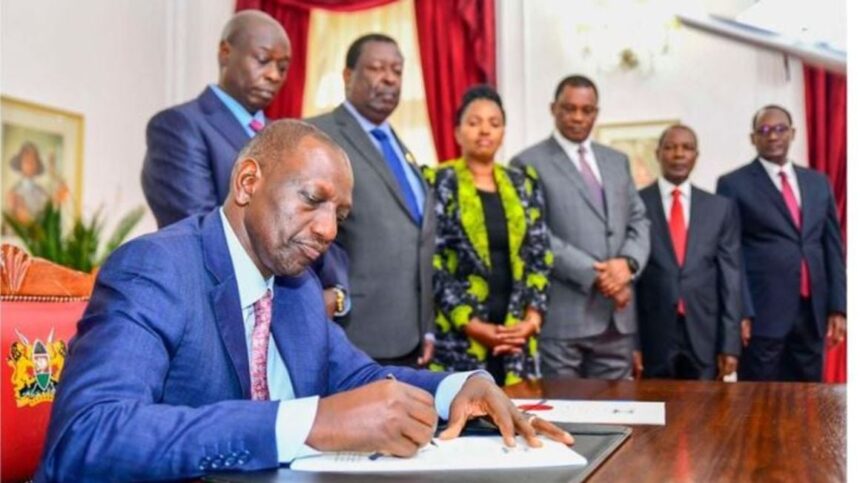
The saga of the housing levy in Kenya, particularly under the administration of President Uhuru Kenyatta and its subsequent developments involving President William Ruto, is a tale of policy aspirations, legal battles, and shifting political landscapes. Here’s an in-depth look at these events:
Introduction of the Housing Levy
Under President Uhuru Kenyatta’s Big Four Agenda, the housing levy was introduced to address Kenya’s acute housing shortage. The agenda, initiated in 2017, aimed to create affordable housing for millions of Kenyans. The government proposed financing this through the National Housing Development Fund (NHDF), which would be funded by a mandatory levy on employees and employers.
Implementation and Backlash
In 2018, the Kenyan government, through the Ministry of Housing, announced the formal introduction of the housing levy. Employers and employees were to contribute 1.5% of the employees’ monthly salary each to the NHDF. This proposal faced immediate opposition from various stakeholders, including employers, represented by the Federation of Kenya Employers (FKE), and workers, represented by trade unions like the Central Organization of Trade Unions (COTU). They challenged the levy on grounds of increased financial burden and potential mismanagement.
Legal Interventions
The housing levy’s implementation saw numerous legal challenges. In April 2019, the Employment and Labour Relations Court in Kenya temporarily halted the levy’s implementation following a petition filed by FKE and COTU. The petitioners argued against the levy’s constitutionality, highlighting issues like lack of adequate public participation and the potential for double taxation.
Shift in Administration and Ruto’s Involvement
The political landscape shifted with the election of William Ruto as President in 2022. Ruto had been critical of the levy, aligning with public sentiment that viewed it as burdensome. Despite this, the need for affordable housing remained pressing.
Ruto’s Legislative Actions
Upon assuming office, President Ruto didn’t immediately scrap the housing levy but sought to modify it to align with his administration’s economic policies. He emphasized public-private partnerships and innovative financing models for affordable housing, suggesting a departure from the mandatory levy system.
Court Rulings and Developments
The Kenyan courts continued to play a significant role in the housing levy saga. Throughout 2019 and 2020, various rulings sought to address the legal and constitutional concerns raised by stakeholders. The courts demanded clearer frameworks for public participation and transparent fund management, putting pressure on the government to revise its approach.
Ruto’s Strategy for Affordable Housing
President Ruto’s administration, while not fully discarding the concept of a housing fund, has focused on creating a more sustainable and less controversial model for financing affordable housing. This includes leveraging private investment and government incentives rather than relying solely on a compulsory public levy.
Ongoing Legal and Political Discourse
As of my last update, the legal and political discourse surrounding the housing levy in Kenya continues to evolve. The courts remain a battleground for defining the limits of government policy in employee income and housing finance. Meanwhile, political leaders, including Ruto, are navigating the challenging terrain of fulfilling housing promises without imposing undue financial strain on citizens.
Conclusion
The housing levy in Kenya is emblematic of the broader challenges faced in implementing large-scale social policies. From Kenyatta’s administration to Ruto’s presidency, the journey of the housing levy intertwines with Kenya’s evolving political, economic, and legal contexts. While the initial mandatory levy faced significant opposition and legal hurdles, the continued pursuit of affordable housing solutions remains a central theme in Kenya’s national policy discourse.